

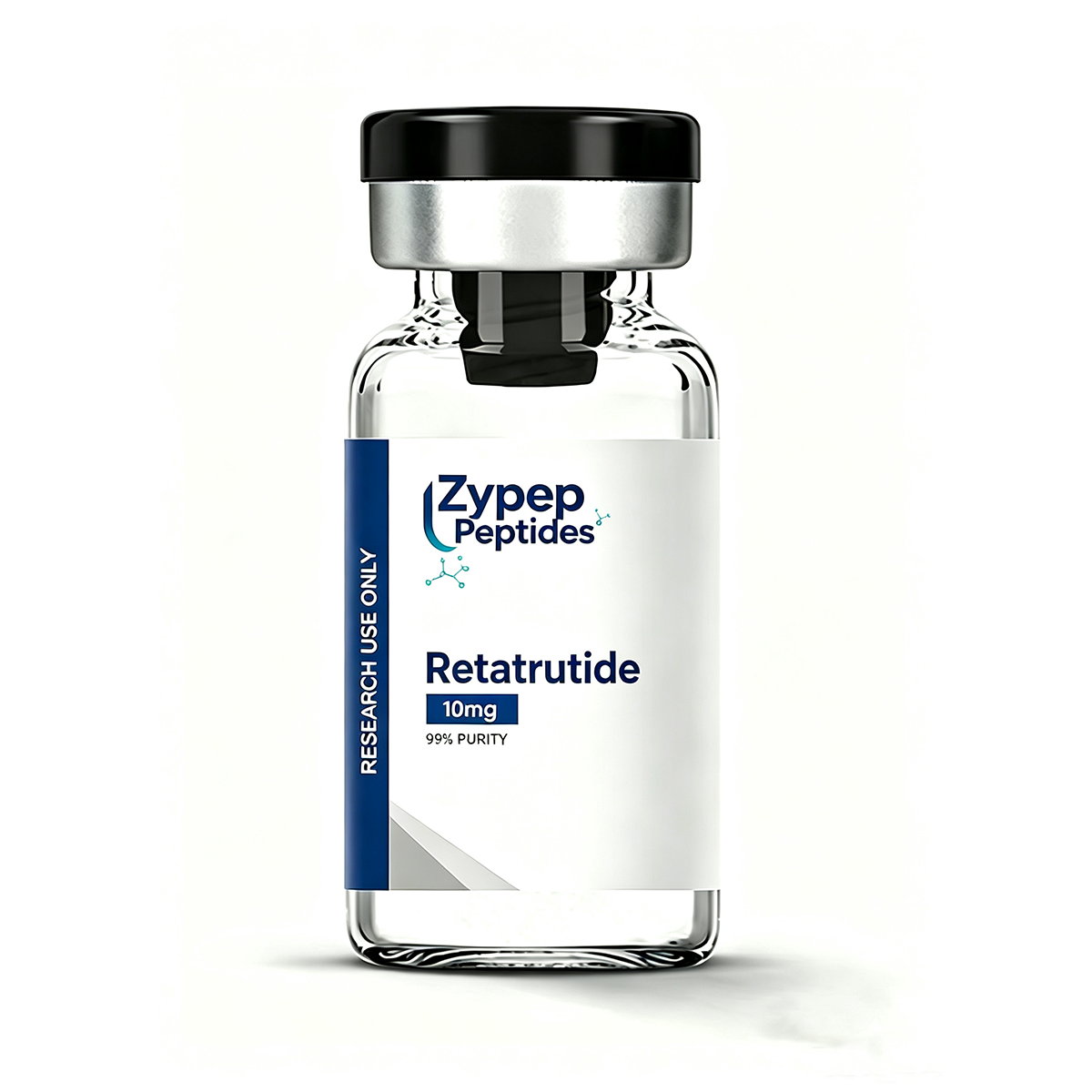
Structurally, retatrutide is built on a GIP peptide backbone with targeted substitutions that introduce cross-reactivity at the GLP-1 and glucagon receptors. Several key modifications contribute to its receptor activity and pharmacokinetic profile:
Aib² (2-aminoisobutyric acid) at position 2 increases resistance to degradation by dipeptidyl peptidase-4 (DPP-4), contributing to the peptide’s prolonged biological activity.
αMeLeu¹³ (α-methylleucine) at position 13 enhances activity at both the GIP and glucagon receptors while helping maintain balanced multi-receptor agonism.
Aib²⁰ (2-aminoisobutyric acid) at position 20 contributes to the peptide’s pharmacokinetic properties and supports its GIP receptor activity.
C-terminal amidation reduces susceptibility to degradation by carboxypeptidases, improving overall peptide stability.
The molecule carries a C20 fatty diacid conjugated through a gamma-glutamate and AEEA linker at a lysine side chain. This enables reversible albumin binding, which drives the long circulating half-life of roughly six days and underpins the once-weekly schedule used across its clinical programme.
| Property | Value |
|---|---|
| Name and synonyms | Retatrutide, LY3437943, LY-3437943, GLP-3, Triple-G, GGG triagonist |
| PubChem CID | 171390338 |
| CAS number | 2381089-83-2 |
| FDA UNII | NOP2Y096GV |
| Molecular formula | C221H342N46O68 |
| Molecular weight | 4731.4 g/mol |
| Peptide length | 39 amino acids |
| Compound class | Synthetic triple incretin receptor agonist |
| Primary targets | GLP-1R, GIPR, GCGR |
| Receptor potency (human EC50) | GIPR 0.0643 nM; GLP-1R 0.775 nM; GCGR 5.79 nM |
| Half-life | Approximately 6 days |
| Physical form | White to off-white lyophilised powder |
| Solubility | Bacteriostatic or sterile water; DMSO; PBS pH 7.2 |
| Developer | Eli Lilly and Company |
| Purity | Please see COA (≥99% HPLC) |
| Vial sizes | Retatrutide 5mg,10mg,15mg,20mg,30mg,40mg,50mg,60mg,100mg |
Retatrutide is one of the newest investigational peptides in the incretin field and has attracted considerable scientific interest owing to its unique triple-receptor mechanism of action. Since its development, published preclinical and clinical studies have investigated its pharmacology, receptor biology, pharmacokinetics, and physiological effects, making retatrutide an increasingly important research tool for the study of metabolic and endocrine signalling.
One of the landmark publications in retatrutide research was the Phase 2 randomised, double-blind, placebo-controlled study published in the New England Journal of Medicine in 2023. The trial established the first comprehensive clinical characterisation of retatrutide across multiple dose levels over a 48-week treatment period, providing valuable information regarding its pharmacokinetics, safety profile, and biological activity. At the highest dose evaluated, investigators reported a mean body-weight reduction of 24.2%, supporting continued investigation of triple-receptor agonism in larger clinical programmes.
Building on these findings, retatrutide progressed into the international TRIUMPH Phase 3 programme. Among the first studies to report results was TRIUMPH-4, a 68-week randomised, double-blind, placebo-controlled trial assessing long-term weight management and cardiometabolic biomarkers in adult obese cohorts. These published datasets serve as primary reference material for comparative triple-incretin laboratory research.
Zypep Peptides provides factory-direct bulk retatrutide lyophilized powder for academic labs, preclinical CROs and peptide research distributors. Submit your inquiry via the website floating chat dialog on zypep.com to receive custom bulk pricing, full batch COA and international shipping details. All products sold exclusively for laboratory research use, not for human consumption.
Reviews
There are no reviews yet.